Which of MSU’s AI & Business Analytics Courses Is Right for You?
Last Updated July 27, 2026
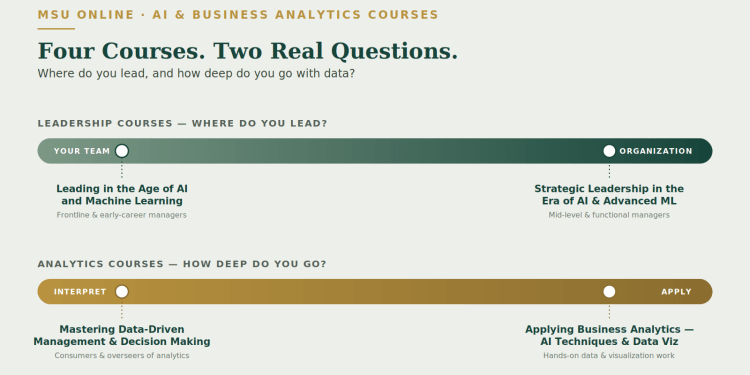
Michigan State University’s AI & Business Analytics course collection offers four short, 100% online courses addressing AI and data from four distinct angles: leading people through AI-driven change, leading AI strategy at the organizational level, building the literacy to interpret data and AI outputs, and hands-on application of AI-assisted analytics tools. All four courses are 100% online, require no technical background to enroll, and are designed for working professionals rather than engineers or data scientists.
The challenge most prospective learners face isn’t finding a course in this collection — it’s figuring out which of several similarly named options fits their role. Here’s how the four break down.
What AI & Business Analytics Courses Does MSU Offer, and How Do They Differ?
The four courses split cleanly along two dimensions: who they’re for (frontline managers vs. mid-level/functional leaders vs. data-facing professionals) and what they focus on (leading people vs. leading strategy vs. interpreting data vs. applying analytics tools).
| Course | Next Start Date | Core Focus | Best For |
| Leading in the Age of AI and Machine Learning | August 1, 2026 | Leading people through AI-driven change | Frontline and early-career managers |
| Strategic Leadership in the Era of AI and Advanced Machine Learning | September 1, 2026 | Leading AI strategy and organizational adoption | Mid-level and functional managers |
| Mastering Data-Driven Management and Decision Making | August 1, 2026 | Interpreting analytics and AI outputs responsibly | Professionals who consume or oversee analytics, not build it |
| Applying Business Analytics — Using AI Techniques and Data Visualization | August 1, 2026 | Hands-on application of AI-assisted analytics tools | Professionals who actively work with data and visualization tools |
What’s the Difference Between “Leading in the Age of AI” and “Strategic Leadership in the Era of AI”?
The difference is altitude, not subject matter — one is about leading your team through AI change day to day, the other is about leading AI strategy across the organization. Both courses cover AI-driven transformation and overcoming resistance, but they’re built for different points in a manager’s career and scope of responsibility.
Leading in the Age of AI and Machine Learning is built for frontline and early-career managers navigating AI change within their own team. It emphasizes practical, people-focused tools — including Kolb’s Learning Styles for supporting individual adaptation and Tuckman’s team development model for moving a team from “Storming” back to “Performing” during disruption.
Strategic Leadership in the Era of AI and Advanced Machine Learning is built for mid-level and functional managers responsible for evaluating AI opportunities and driving adoption across teams or functions, not just their own. It emphasizes structured frameworks for assessing AI strategy, communicating it to senior leadership, and scaling initiatives with governance and performance frameworks once they move past initial implementation.
In short: if your job is keeping your own team steady and productive through AI change, start with Leading in the Age of AI. If your job is deciding which AI initiatives to pursue and scaling them across functions, Strategic Leadership in the Era of AI is the better fit.
What’s the Difference Between “Mastering Data-Driven Management” and “Applying Business Analytics”?
The difference is conceptual literacy versus hands-on application. Both courses are built for non-technical professionals who work with data-driven insights, but they ask different things of the learner.
Mastering Data-Driven Management and Decision Making focuses on understanding how analytics and AI systems produce their outputs — the difference between data, information, and insight; how neural networks and generative AI interpret complex information; and the tradeoffs between transparent analytics models and “black-box” AI systems. It’s built for professionals who need to critically evaluate and communicate analytics findings, not build the models themselves.
Applying Business Analytics — Using AI Techniques and Data Visualization goes a step further into hands-on application, using tools like Excel and Power BI to build and assess actual visualizations, apply clustering techniques to customer segments, and interpret regression models, A/B tests, and classification techniques like decision trees and logistic regression.
In short: if you need to interpret and critically question analytics outputs your team or vendors produce, Mastering Data-Driven Management is the foundation. If you need to build visualizations and run basic analyses yourself, Applying Business Analytics adds the applied layer on top.
Do Any of These Courses Require a Technical Background?
No. All four courses are explicitly designed for professionals without a technical or data science background. The two leadership-focused courses (Leading in the Age of AI and Strategic Leadership in the Era of AI) require no data or technical skills at all — they’re built around organizational leadership, not tools. The two analytics-focused courses require comfort working with data but are built to teach interpretation and application, not programming or model-building.
Which Course Should You Take Based on Your Role?
| If You Are… | Start With |
| A frontline or first-time manager whose team is uncertain about AI adoption | Leading in the Age of AI and Machine Learning |
| A mid-level or functional manager responsible for evaluating and scaling AI initiatives | Strategic Leadership in the Era of AI and Advanced Machine Learning |
| A manager or professional who reviews analytics/AI outputs but doesn’t build them | Mastering Data-Driven Management and Decision Making |
| A professional in marketing, operations, finance, or customer analytics who works hands-on with data tools | Applying Business Analytics — Using AI Techniques and Data Visualization |
Can You Take More Than One of These Courses?
Yes, and for many professionals, they’re designed to complement rather than duplicate each other. A common pairing is one leadership-focused course (people or strategy) alongside one analytics-focused course (interpretation or application) — giving a manager both the organizational skills to lead AI adoption and the literacy to evaluate whether the AI initiatives themselves are producing sound results.
For managers moving up from a frontline to a functional leadership role, taking Leading in the Age of AI followed by Strategic Leadership in the Era of AI in a later term also maps naturally onto that career progression.
When Do These Courses Start, and How Long Do They Take?
Three of the four courses — Leading in the Age of AI and Machine Learning, Mastering Data-Driven Management and Decision Making, and Applying Business Analytics — begin August 1, 2026. Strategic Leadership in the Era of AI and Advanced Machine Learning begins September 1, 2026. All four are delivered 100% online.
Frequently Asked Questions
Do I need a technical or AI background to take any of these courses? No. All four courses are built for professionals without a technical or data science background, though the two analytics-focused courses assume comfort working with data.
What’s the difference between a “leadership” course and an “analytics” course in this set? The leadership courses (Leading in the Age of AI and Strategic Leadership in the Era of AI) focus on managing people and organizational change around AI adoption. The analytics courses (Mastering Data-Driven Management and Applying Business Analytics) focus on interpreting and applying data-driven and AI-generated insights.
I’m a frontline manager — which course should I take first? Leading in the Age of AI and Machine Learning is built specifically for frontline and early-career managers navigating AI-driven change within their own team.
I need to evaluate AI vendor proposals and outputs, but I don’t build models myself — which course fits? Mastering Data-Driven Management and Decision Making is designed for exactly this audience: professionals who need to interpret and critically assess analytics and AI outputs without building the underlying models.
Can I take these courses toward a broader credential, or are they standalone? Each course is a standalone. Check current program pages for details on whether credits or completions apply toward a broader certificate or degree pathway.
Find Your Starting Point
With four courses in MSU’s AI & Business Analytics collection covering people leadership, strategic decision-making, data interpretation, and applied analytics, the right starting point depends less on how much you already know about AI and more on what your role asks of you day to day. Review the course pages linked above for full curriculum details, tuition, and registration deadlines for the August 1 and September 1, 2026 start dates.