From Military Logistics to Civilian Supply Chain: Building on Your Experience with MSU’s Online M.S. Program
Last Updated September 25, 2026
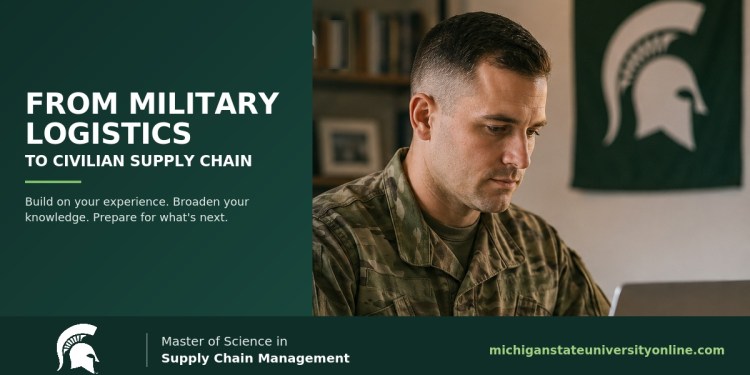
Military service can provide experience in logistics, procurement, operations, planning and resource management. For veterans preparing for a civilian career, graduate education can be one way to build on that experience while developing a broader understanding of supply chain management.
Michigan State University’s Master of Science in Supply Chain Management is a 31-credit graduate program designed for experienced supply chain professionals. The program combines eight-week online courses with three required three-day residency weekends on MSU’s campus in East Lansing, Michigan.
For veterans considering graduate school, understanding how their experience aligns with the program and how its requirements fit their plans after service can help inform the decision.
Building on Military Experience
Depending on their roles and responsibilities, veterans may bring experience in:
- Logistics and transportation
- Procurement and contracting
- Inventory and material management
- Operational planning
- Resource coordination
- Risk management
- Project management
- Team leadership
These experiences can provide a foundation for further study, although military and civilian organizations may use different terminology and processes.
MSU’s curriculum examines supply markets, sourcing, logistics, data analysis, global supply chain management, technology and innovation, quality and lean enterprise, and supply chain strategy. Students also complete a field study or research project that applies program concepts to an organizational problem or opportunity.
Graduate coursework can provide another perspective on familiar operational challenges while expanding knowledge of how supply chains function across organizations and industries.
What You’ll Study
MSU’s curriculum covers a range of supply chain disciplines, including:
Supply Markets and Sourcing
Students examine category sourcing strategies, supplier evaluation, cost modeling, supply chain risk, digital procurement and collaborative supplier relationships.
Logistics and Supply Chain Management
Coursework covers product flow, procurement, sourcing, forecasting, demand fulfillment, reverse logistics, production and operations management, and methods for improving supply chain processes.
Applied Data Analysis
Students develop knowledge of quantitative and statistical methods used in supply chain, operations, logistics and related business functions.
Global Supply Chain Management
The curriculum examines global supply chain strategy, international logistics, purchasing and operations, and factors that influence supply chain decisions across markets.
Strategy and Applications
The capstone integrates concepts from across the program through cases, simulations and applied supply chain analysis.
Connecting With Other Supply Chain Professionals
A graduate program can also provide opportunities to build professional relationships outside the military community.
MSU’s required residency sessions bring students together for face-to-face learning, collaboration and networking. Activities include discussions, case studies, breakout sessions and simulations. The program includes three three-day Friday-through-Sunday residencies in East Lansing. Hotel accommodations, meals and classroom costs associated with the residencies are included in the program cost; students are responsible for travel expenses.
For veterans entering or exploring the civilian supply chain field, these sessions can provide opportunities to interact with professionals from different industries and backgrounds.
Funding Graduate Education After Service
Eligible veterans may be able to use GI Bill® benefits toward graduate education. The U.S. Department of Veterans Affairs notes that GI Bill benefits can be used for graduate degree programs, with eligibility and payment amounts varying based on the individual’s benefit, enrollment and other circumstances.
Employer tuition assistance may also be available depending on an individual’s employer and benefits package.
Veterans should confirm their eligibility and current benefit amounts with the VA and their employer or other funding source before making enrollment or financial decisions.
Admissions Considerations for Veterans
Military experience in logistics, procurement, operations or related areas may be relevant to an applicant’s professional background. However, applicants should review MSU’s requirements rather than assume that any military position automatically satisfies the program’s experience requirement.
MSU currently requires applicants to have:
- A bachelor’s degree with at least a 3.0 overall undergraduate GPA
- At least two years of professional supply chain work experience
Applicants should also review the program’s current application requirements, including recommendations, personal statements and standardized testing policies.
Because military occupational specialties and responsibilities vary, veterans who are unsure whether their experience meets the supply chain work experience requirement should contact MSU before applying.
Preparing for the Next Stage
Military experience can provide a strong professional foundation in areas related to supply chain management. Graduate study can build on that experience while providing additional academic knowledge in sourcing, logistics, analytics, technology and supply chain strategy.
Explore Michigan State University’s online Master of Science in Supply Chain Management to review the current curriculum, admissions requirements, residency schedule and program details.
Program requirements, course offerings, tuition and other details are subject to change. Prospective students should consult official Michigan State University resources for the most current information. Educational attainment does not guarantee employment, promotion, salary increases or specific career outcomes. Individual results vary based on factors including experience, industry, geographic location, employer requirements and market conditions. GI Bill® benefit availability, eligibility and amounts vary by individual circumstances. Prospective students should consult the U.S. Department of Veterans Affairs and appropriate funding sources for current information. GI Bill® is a registered trademark of the U.S. Department of Veterans Affairs (VA).